
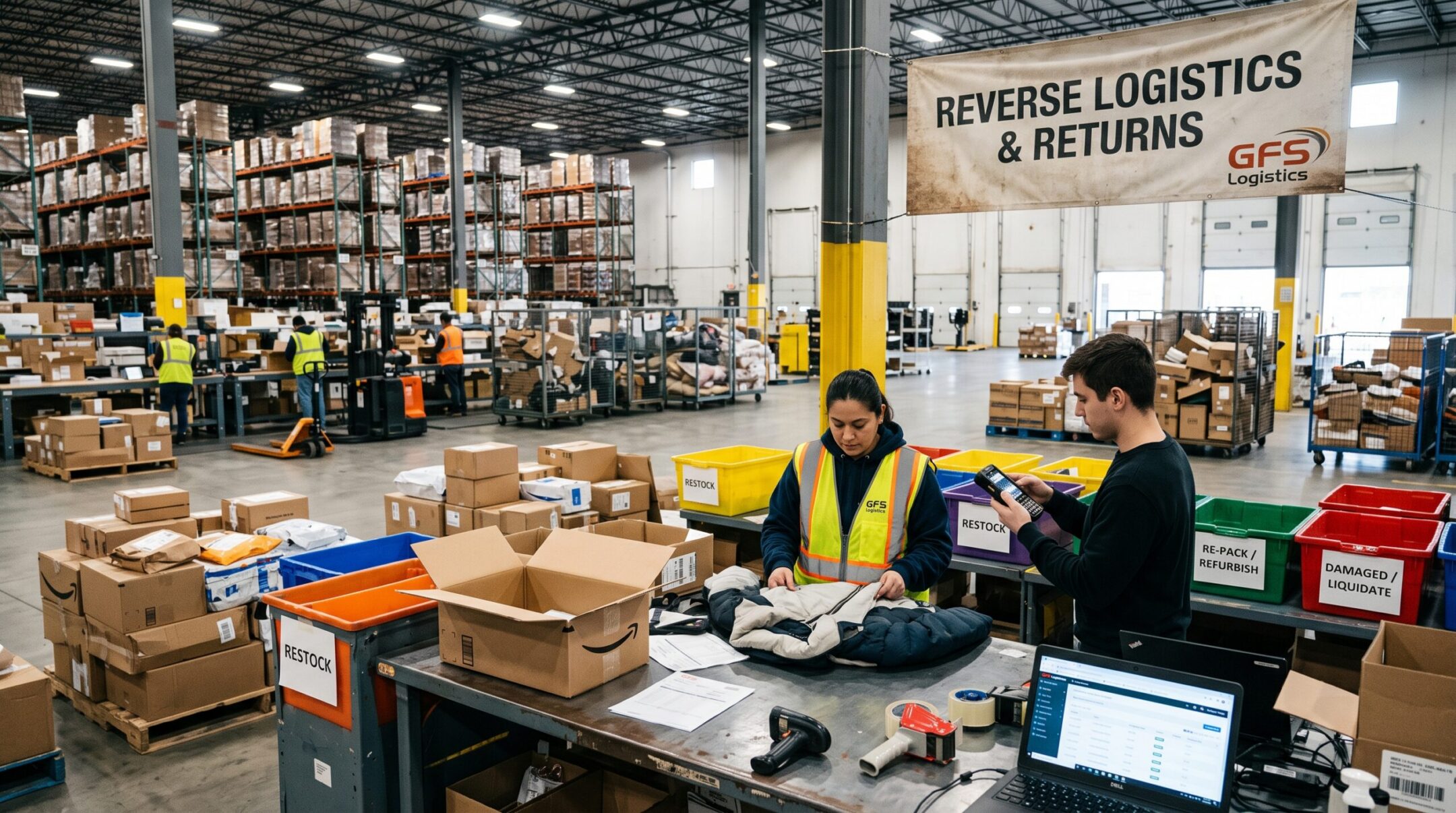
The holiday rush ends. The boxes start coming back.
Retailers expect about 17% of holiday sales to be returned, according to the National Retail Federation (NRF). Online orders run higher. Those returns do not arrive evenly. Return requests jump roughly 25% to 45% above normal right after Christmas. January becomes the hardest month of the year for any receiving dock.
This is the breaking point. Pallets of returns stack up faster than the team can open them. Items sit unchecked while seasonal demand fades. Sellable product gets written off simply because nobody had time to inspect it.
Reverse logistics services are a structured process for receiving, inspecting, sorting, photographing, and restocking or liquidating returned goods. Done well, a return becomes a second chance at a sale. Done poorly, it becomes a loss.
A warehouse management system tracks each returned item from the dock to its next destination. Dedicated floor space in the DFW area keeps returns from clogging outbound work. The goal is simple. Turn slow, messy processing into fast inventory turnaround.
The Cost of Post-Holiday Return Friction: How Unmanaged Returns Bleed Margins
Forward Shipping and Reverse Logistics Are Different Jobs
Outbound fulfillment is predictable. You know what is in the order. You know where it sits. You pick it, pack it, and ship it.
Returns flip that script. The item arrives in unknown condition. It may be unopened, used, damaged, or the wrong product entirely. Someone has to decide what happens next. That decision takes judgment, and judgment takes time.
Many brands treat returns as an afterthought. They assign a few people and hope for the best. In January, hope runs out. A team built for a normal week cannot absorb a spike of three to five times the usual volume.
Slow Processing Costs Real Money
The cost of a single return adds up quickly. Published estimates run from about $10 to $65 per item. That range covers return shipping, labor, restocking, and write-offs. Some analysts put the fully loaded cost near 27% of the purchase price.
Manual processing makes it worse. A box sits for a week. A seasonal item misses its selling window. A coat returned in January is worth less by February. A misplaced unit never gets counted at all. Each delay chips away at the value of the product inside.
Customers feel the delay too. A refund waits until the item is checked in. Slow check-in means slow refunds. Frustrated shoppers are less likely to buy again.
Inventory Velocity Applies in Reverse
Inventory velocity is how fast product moves through your operation. Most brands track it for outbound goods. Few track it for returns.
They should. A returned item is stuck until someone marks it available. During that time, it earns nothing. It also hides from your inventory management records. Your system may show a stockout while a sellable unit sits in a returns bin.
Cash flow suffers as well. Every day a good item waits is a day of tied-up capital. Getting returns back to “Available” status quickly protects the money you already spent on that product.
Strategic Returns Processing: Inspection, Photo Documentation, and Restocking
Multi-Step Receiving and Inspection
Strong returns processing starts with a clear standard operating procedure. Staff open each return and follow the same steps every time. They check the item against the original order. They look for wear, damage, and missing parts.
Then they assign a grade. Some items are like new and go straight back to stock. Others need cleaning, repackaging, or light refurbishing first. The rest are not worth restocking and move to liquidation. Each path recovers more value than a blanket write-off.
Speed matters here. The sooner an item is graded, the sooner it either sells again or exits the building. Quick decisions keep the dock clear and the numbers moving.
Photo Documentation at Receipt
Photos protect everyone involved. When staff receive a damaged or defective return, they snap images on the spot. The pictures attach to the order record in the warehouse management system.
That record settles disputes fast. If a customer claims the item arrived broken, you can check the photos. If a vendor must cover a defect, you have proof ready. Nobody argues from memory.
Photos also help your team on the brand side. You can view the condition of returns without calling anyone or waiting on a written report. Decisions that once took days can happen in minutes.
Systems That Talk to Your Cart
A returns program only works at speed if your systems share data. Your reverse logistics services should connect directly to your shopping cart, whether that is Shopify, BigCommerce, or another major platform.
When a return clears inspection, the cart should update right away. The item returns to available stock. The customer gets a notice. The refund can move forward. No one retypes anything.
Without that link, staff must update each system by hand. Errors creep in. Stock counts drift. A solid warehouse management system removes those gaps and keeps every record in sync.
The Hidden Benefits: Customer Retention and SKU Quality Control
Easy Returns Build Loyalty
Shoppers judge a brand by how it handles problems. A clear, fast return process builds trust. Surveys show that most consumers say free returns matter when they choose where to shop.
Speed is part of that experience. A customer who gets a refund in days feels respected. One who waits weeks starts looking elsewhere. Fast processing turns a frustrating moment into a reason to come back.
For customer success teams, this is a real advantage. Fewer “where is my refund” tickets means more time for useful work.
Return Data Becomes a Quality Control Tool
Returns also tell you something. Every item that comes back has a reason. Sorting those reasons gives you a map of what is going wrong.
Say one SKU keeps returning with cracked corners. That points to a packaging problem. Another product returns as “not as described.” That points to a listing problem. A third fails after a week. That points to a manufacturing problem.
Your inventory management system can track these patterns by SKU. Spot a trend early, and you can fix it before it spreads. Without that data, the same defect repeats season after season.
This feedback loop is where returns stop being a cost and start being a source of insight.
Scaling with GFS: Technology as a Service
No Separate Returns Facility Required
Growing brands often assume they need their own returns center. That means more space, more staff, and more systems to manage. It is a heavy lift for a business already stretched by growth.
There is an easier route. GFS Logistics already runs turnkey reverse logistics services. The workflows are in place. The staff knows the process. The enterprise warehouse management system is already connected to major shopping carts through API integrations.
Your brand can scale volume without building anything new. NRF found that 49% of retailers planned to lean more on third-party logistics partners for holiday returns. That shift reflects how hard it is to do this work in-house.
Built for the January Spike
Our facility covers more than 1.6 million square feet. That scale gives returns their own space. Outbound orders keep moving while returns get processed. One does not stall the other.
Clients see everything through a 24/7 web portal. Returned items, inspection status, and restocked units show up in the same view as regular inventory. Once an item is cleared, it can be redistributed quickly across the DFW freight corridors.
The result is a returns program that grows with your order volume. A big Q4 promotion no longer means a January pileup.
Plan Your Returns Program Before the Rush
October is the time to prepare. The orders have not peaked yet. The returns have not arrived. You still have room to build a plan.
Start by mapping your expected return volume. Apply a realistic holiday return rate to your sales forecast. Multiply that by your true cost per return. That number shows what the season will cost before a single refund goes out.
Treat returns as a revenue channel, not a chore. The brands that do this recover more value and lose fewer customers. GFS Logistics gives e-commerce operators, D2C founders, and supply chain managers a clear path to get there, with the space, the systems, and the team already in place. Contact us today to learn more about how we can ease the stress of reverse logistics.