
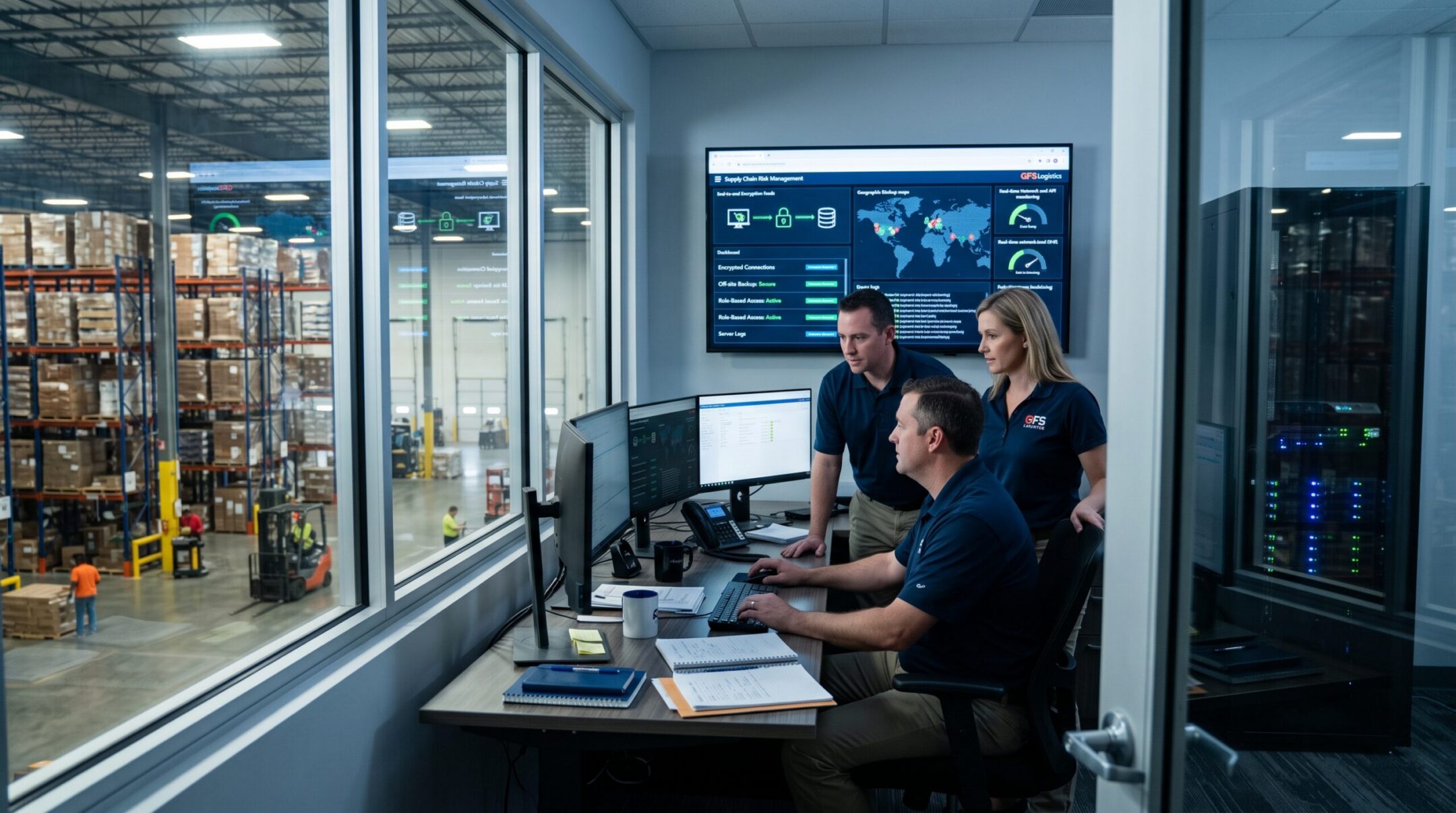
A 3PL protects your data when it can prove five things: Encrypted connections, off-site backups, role-based access, a tested outage plan, and written response steps. GFS Logistics builds its operation around those standards.
We understand that the risk of working with online networks has substantially grown. Attackers have moved on from large enterprises, to the smaller vendor with a trusted connection. This means every new shopping cart, ERP feed, or warehouse portal is a potential entryway for a cyberthreat.
GFS stays a step ahead with supply chain risk management. Our team applies enterprise-grade data security protocols across its DFW warehouse ecosystem. That includes geographic server redundancy and continuous system monitoring. Need a secure partner for your logistics coordination? We’ll show you what your 3PL should practice, and why GFS should be your first choice.
The Escalating Cyber Threat Landscape in 3PL Logistics
Mid-market 3PLs are targets because they are a shortcut. A logistics vendor holds data from many clients. It also connects to many systems. One breach can open dozens of doors.
Physical Security Is Not Enough
A fence and a camera guard the building. They do nothing about a stolen password. A thief on the other side of the world can empty a customer database without touching a single pallet.
This is why supply chain risk management now has to include the vendor’s digital habits. Where a 3PL stores data, who can reach it, and how it connects to your systems all matter. Those facts decide your exposure.
What a Breach Does to the Dock
The cost shows up in two places. The first is the invoice for recovery. IBM’s research puts the average supply chain breach close to $5 million. It also can take more than eight months to find and contain.
The second cost is the dock itself. Picture a ransomware event at your 3PL. There may be no physical damage on site, but if the WMS is locked, pickers can’t review lists, labels won’t print; and the list of problems holding up shipments goes on!
Something as small as a phishing email or reused password can be the catalyst to quiet damage your business won’t easily recover from.
What to Require from Your 3PL Partner
Ask for three things in writing: encryption, redundancy, and access control. Each one answers a specific failure.
End-to-End Encryption and Secure API Connectors
Order feeds carry customer names, addresses, and payment details. Manifests carry financial data. All of it should travel through encrypted channels, and it should stay encrypted while stored.
Your supply chain management software is only as safe as the weakest connection feeding it. Ask how API keys are stored and how often they change. Ask who can see them. Clear answers show a vendor that treats these links as serious.
Geographic Redundancy and Automated Backups
Backups matter only if they survive the same event as the original. A copy sitting in the same building is not a backup. It is a second target.
Good practice keeps copies in a separate region. The process runs automatically, so no one has to remember it. Then comes the key question: when did the vendor last test a full restore? A backup that has never been restored is a guess.
Role-Based Access Controls
Role-based access means each person sees only what their job requires. A picker does not need billing data. A client user does not need administrator rights.
This stops credential misuse before it spreads. Credential abuse was behind roughly one in five breaches in Verizon’s 2025 data. Strong controls limit the damage when one login is stolen. Ask also how fast access is removed when someone leaves. The answer should be the same day.
The Hidden Benefits: Audit Preparedness and Business Continuity Protocols
Written protocols make audits faster. Corporate risk reviews ask for evidence. A 3PL with documented response steps, backup logs, and access reviews hands you that evidence on request.
Passing Audits Without the Scramble
Supply chain directors often carry the audit burden for vendors they do not control. Each gap in a vendor’s paperwork becomes your gap. Compliance fines and failed reviews follow.
A documented cyber response plan changes that. You can show who does what, in what order, within what time. Auditors see a process instead of a promise. That speeds approvals and builds trust inside your own company.
Keeping the Dock Moving During an Outage
Planning for continuity means assuming something will fail. A good 3PL builds contingency operations ahead of time. That includes manual override steps and isolated backup systems.
With those in place, picking, packing, and shipping can continue during network maintenance or an outage. Orders still leave on time. Customers never learn there was a problem. That is the real test of supply chain risk management: the customer sees nothing.
Scaling with GFS Logistics
Growing brands do not need to build their own security team to be safe. They can use a partner whose protections are already in place.
Building secure IT infrastructure takes people, tools, and years of upkeep. For a brand focused on selling product, that is a heavy lift. A 3PL with an existing, secure technology stack removes that burden from day one.
GFS Logistics offers that stack from its Lancaster facility. Clients get enterprise-grade WMS security and direct API shopping cart integrations. They also get 24/7 web portal monitoring. The facility sits among the main DFW freight hubs, so physical and digital operations run from one place.
Scalability matters here too. New sales channels and API connectors will come as your brand grows. Each should be added without weakening the network around it. Strong standards make that possible. GFS focuses on those standards and compliance outcomes, not on publicizing its internal design. That is how security should work.
Avoid Cyber Risks for Your Logistics With GFS
Cyber risk now arrives through the vendors you trust. A 3PL is part of your security perimeter, so it should be judged like one. Encryption, redundancy, access control, and a tested continuity plan are the baseline.
Treat these as part of your supply chain risk management program, not a side check for the IT team. Brands that do this protect their data, their docks, and their customers at once.
GFS Logistics gives IT procurement leads, risk officers, and operations directors a secure partner in the logistics sector. The protocols are in place. The systems are monitored. Your growth can move forward on a safer foundation. Contact us today!